
CLINICAL TRIALS PROVE CANINE MASSAGE THERAPY REDUCES SEVERITY OF PAIN IN THE MAJORITY OF DOGS
The Canine Massage Guild, in conjunction with Winchester University and University Centre Sparsholt, has conducted the world’s first ever clinical trials into the efficacy of clinical canine massage therapy and specifically the Lenton Method®.
The findings from the first ever large-scale study into the efficacy of clinical canine massage on the treatment of pain have been published in Vet Record, the official journal of the British Veterinary Association (BVA). The study is the first of its kind to produce clinically verifiable evidence from a cohort of 527 cases.
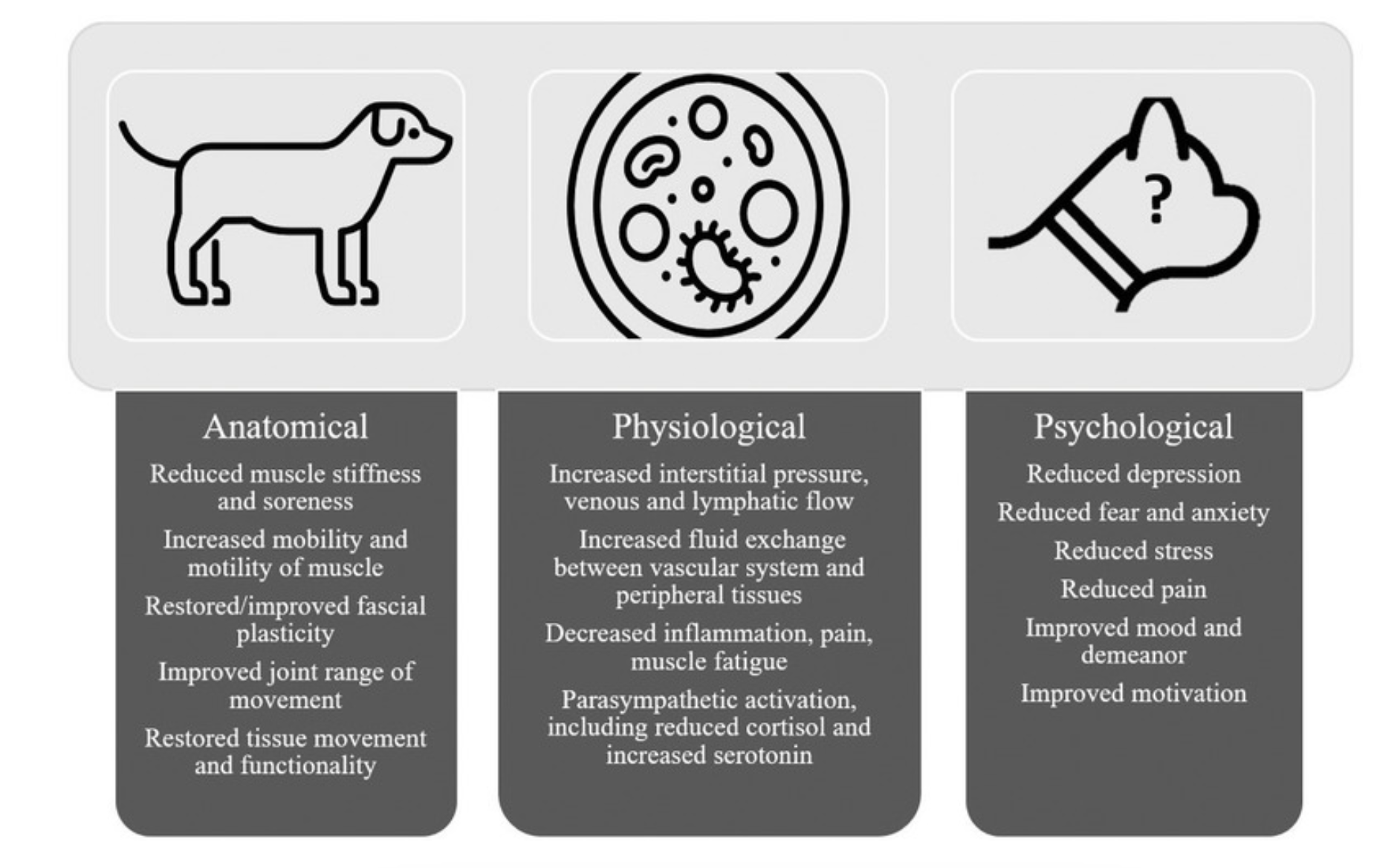
Dr Lisa Riley, Lecturer in Animal Welfare, comments: “To our knowledge, this is the most comprehensive quantitative analysis of the effects of canine massage therapy to date globally. By reviewing owner- and practitioner-rated pain severity scores we have shown that, in our sample of dogs, pain severity significantly reduced after just one massage therapy session and continued to significantly reduce with each subsequent treatment.
Collectively dog pain severity went from ‘moderate’ to ‘mild’. Importantly, practitioners considered the dogs’ quality of life improves following treatment. This study suggests massage therapy may be a meaningful inclusion in a musculoskeletal pain management plan.”
The Methodology
With veterinary consent, Canine Massage Guild practitioners employed the Lenton Method® to treat muscular and myofascial conditions in dogs of all ages and across many breeds. The study looked at whether massage positively affected the quality of life of dogs experiencing chronic pain, lameness, signs of ageing, athletic performance and subclinical signs of pain as reported by owners.
The practitioners were asked to complete a standardised report per dog documenting life history variables (e.g., age, breed, sex), clinical diagnoses and known or deduced aetiologies, and number, severity (score) and improvement status (improved/worsened/no change) of each of 5 principles of pain parameters (gait, posture, ADLs, behaviour, performance) prior to massage therapy and again after a course of three, hour-long massages.
Finally, in consultation with the subject’s owner, the practitioner considered post-treatment results and these data were submitted to the University from across the UK, Ireland, and Spain.

The Results
Out of 527 dogs, 492 dogs responded to treatment. The variables between cases such as age, breed and conditions were of a diverse enough range to ensure the type of dogs that therapists see in practice were represented. Whilst there are many reasons for whether or not a dog is responsive, this result evidenced that veterinary-diagnosed musculoskeletal conditions responded successfully after clinical canine massage therapy. Positive changes in the dogs’ mobility and behaviours were often observed after just one treatment, increasing with subsequent sessions.
This study is part of a wider suite of studies with the gold standard of double-blind trials already planned with the Canine Massage Guild and Winchester University in the future.
Read the full research in the Vet Record.